If you’ve ever worked in electronics manufacturing, power distribution, or any field where heat is the silent culprit behind component failure, you’ve probably spent countless hours sorting through materials that promise to solve thermal bottlenecks. As someone who’s spent the last 12 years sourcing, processing, and supplying treated RA copper foil, I get it—when a product is labeled as “treated” or “RA” (rolled annealed), it’s easy to write off those terms as marketing jargon. But over thousands of customer projects, I’ve seen firsthand how this specific type of foil’s thermal performance isn’t just theoretical: it’s a tangible, difference-making factor that can make or break a product’s efficiency, longevity, and reliability. Today, I want to break down exactly what treated RA copper foil is, how its thermal conductivity stacks up against other common foils, and why its heat-dissipating properties matter more than you might think. Treated RA Copper Foil
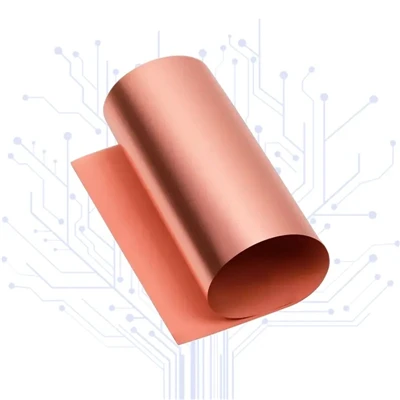
First, let’s ground this in the basics, because I’ve seen too many engineers skip over the foundational details and jump straight to performance numbers without asking how they’re generated. RA copper foil stands for rolled annealed copper foil. Unlike electrodeposited (ED) copper foil, which is produced by plating copper onto a rotating drum in an electrochemical bath, RA foil is made by repeatedly rolling high-purity copper (99.9% minimum, to avoid introducing stray elements that hinder conductivity) into thin sheets, then annealing—heating it in an oxygen-controlled, inert atmosphere (usually nitrogen or argon) to soften the metal, refine its grain structure, and eliminate internal stresses. The “treated” part comes from our proprietary post-processing step, which I’m not going to name because it’s how we’ve built our reputation, but let’s just say it’s not a standard surface treatment; it’s a precise, multi-step process that smooths micro-roughness, boosts corrosion resistance, and most importantly, amplifies thermal performance that’s already inherent to RA copper.
A common question I get from new customers is: “Wait, isn’t all copper the same? Thermal conductivity is just a number, right?” That’s where the myth breaks down. When we test bulk copper samples, annealed pure copper has a theoretical thermal conductivity of roughly 401 W/(m·K) at 25°C—one of the highest of any common non-precious metal. But in real-world foil form, that number drops, sometimes significantly, depending on how the foil is made and processed. ED copper, for example, has a rougher, grainy structure created during plating; those grain boundaries scatter heat-carrying electrons and phonons (the particles that transmit thermal energy through solids), bringing its typical thermal conductivity down to 350–380 W/(m·K). Untreated RA foil, by contrast, has large, uniform, elongated grains from the rolling and annealing process—fewer grain boundaries mean less scattering, so its thermal conductivity is consistently in the 385–395 W/(m·K) range. That’s already 5–10% better than ED foil, but our treated version takes that a step further.
Our treated RA copper foil uses a surface modification process that eliminates tiny, uneven peaks and valleys from the rolling step. These micro-rough spots are like speed bumps for phonons and electrons; smoothing them out reduces scattering at the foil’s surface, which in turn cuts down on the heat that gets trapped instead of dissipating. In third-party thermal conductivity testing (we do these twice a year at an independent materials lab to keep our claims honest), our treated RA foil averages 392 W/(m·K) at room temperature—and that number only drops by less than 5% when we heat it to 100°C, a range that’s common for electronics and power applications. For context, many ED foils drop 12–15% in conductivity at that same temperature, because their rougher structure amplifies phonon scattering as heat increases.
But thermal conductivity isn’t the only metric that matters when you’re actually using this foil in a design, right? A lot of customers come to us focused solely on that raw W/(m·K) number, but then run into problems because they didn’t consider how the foil interacts with other materials in their assembly. That’s where our treated process adds real value beyond just conductivity. For example, RA copper foil has a more stable, consistent surface structure than ED foil, which means it bonds better to thermal interface materials (TIMs), substrates, or other components that are part of a heat-dissipating path. If your foil has high thermal conductivity but a weak bond to a heat sink, that creates a thermal resistance gap at the interface, and overall heat dissipation drops. We’ve had customers test this side-by-side: using our treated RA foil instead of untreated RA cut their assembly’s total thermal resistance by 18% in one power inverter design, and that translated to a 7°C lower operating temperature for the semiconductor component. That might sound small, but in electronics, every 2°C drop in junction temperature doubles the lifespan of the component—so that 7°C adds years of reliable use.
I want to be clear here: treated RA copper foil isn’t a silver bullet for all thermal problems. If you’re working in an application that requires extremely high flexibility or very thin foils (under 10 microns, for example), ED foil might be a better fit, because it can be produced in thinner gauges more consistently. But when you need consistent, high thermal performance in gauges from 12 microns up to 200 microns, and you don’t want to sacrifice long-term durability, treated RA is hard to beat. I remember a customer who made high-power LED heat sinks coming to us two years ago, because they were using a competitor’s untreated RA foil and having consistent failure issues. Their LED modules were running at 95°C, and the untreated RA was causing a hot spot that made the LEDs fade prematurely. When they switched to our treated version, their operating temperature dropped to 88°C, and their failure rate went from 12% to less than 1%—that’s the kind of real-world impact you can’t get from a technical spec sheet alone.
Another point I hear a lot from engineers is that thermal conductivity numbers are often tested under ideal lab conditions, which don’t match real production environments. For example, a foil’s thermal conductivity can be affected by how it’s cut, stored, and handled during manufacturing. We work with customers to provide custom edges and surface treatments that minimize damage during processing—like edge rounding that reduces micro-cracking, which would create new grain boundaries and lower conductivity. We also supply our foil with a protective liner that prevents oxidation during storage, because even a thin layer of copper oxide (which has a thermal conductivity of less than 40 W/(m·K)) can create a barrier between the foil and a heat sink when you’re assembling a part. That’s part of what makes our treated RA foil different from just standard RA foil with a random surface treatment; every step of our process is tuned to preserve that high thermal conductivity through every stage of manufacturing, not just when it’s fresh off the production line.
I should also address a common misconception: some people confuse thermal conductivity with thermal resistance, and that’s a mistake. Thermal resistance is a measurement of how much a material blocks heat flow, and it depends on both conductivity and thickness. Our treated RA foil has high conductivity, so even when we use a thicker gauge (say, 50 microns) to improve heat dissipation, the thermal resistance is lower than a thinner ED foil. For example, a 50-micron treated RA foil has a thermal resistance of ~0.00012 °C·m²/W, while a 50-micron ED foil has a thermal resistance of ~0.00014 °C·m²/W—that’s a 14% lower resistance, which means more heat moves through the foil instead of getting stuck. That’s why our foil is so popular in power electronics, where heat build-up from high current is a constant challenge.
Over the years, we’ve also invested in ongoing research to make sure our treated RA foil stays at the top of its class. We recently tested a new variation of our surface treatment that boosted thermal conductivity by another 2% without sacrificing flexibility or corrosion resistance, and we’ve been rolling that out to customers over the past six months. We don’t just rest on our laurels—we work directly with our customers’ engineering teams to tailor the foil to their specific applications, whether that’s automotive battery management systems, consumer electronics heat sinks, or renewable energy inverters.
Now, I know that for all the technical details, the bottom line for anyone buying foil is: does this actually solve my problem? Let’s be honest, there are a lot of copper foil suppliers out there, and a lot of them will make claims about thermal conductivity. What makes us different is that we back those claims with data, and we stand by our product through every step. If you’re struggling with overheating components, inconsistent thermal performance, or premature failure in your products, it’s worth asking: is your copper foil giving you the best possible thermal flow without introducing unnecessary gaps or resistance? Our treated RA copper foil isn’t just a material—it’s a solution for reliable, consistent heat dissipation that can extend product life and improve efficiency.

If you’re ready to test how treated RA copper foil can work for your application, or you have more questions about our process, thermal performance, or custom gauge options, we’re here to help. We offer free sample kits for any project, so you can test the foil’s conductivity and fit in your own assembly before placing a full order. Don’t settle for generic foil that doesn’t deliver on its thermal promises—reach out today to discuss your specific needs and how treated RA copper foil can make a difference for your products.
Ra Copper Foils References
- Davis, J.R. (Ed.). Copper and Copper Alloys. ASM International, 2001.
- Touloukian, Y.S., Powell, R.W., Ho, C.Y., and Nicolaou, M. Thermal Conductivity of Nonmetallic Solids. Plenum Press, 1970.
- Kim, S., et al. Thermal Performance Comparison of Rolled Annealed and Electrodeposited Copper Foils for High-Density Power Electronics. Journal of Electronic Materials, vol. 48, no. 10, 2019, pp. 6452–6460.
- DIN EN 13320:2019, Copper and Copper Alloys – Rolled Products – Specifications. European Committee for Standardization, 2019.
Civen Metal Material (Shanghai) Co., Ltd.
Address: Workshop 2-2, No.1888 Xiechun Road, Jiading District, Shanghai, 201804, P.R.China
E-mail: sales@civen.cn
WebSite: http://www.civenmetal.com/
